

Inventory, Advertising, Fulfillment & Working Capital: The Decisions Shaping Q4 Performance
Amazon's Prime Big Deal Days concluded on October 7. Black Friday and Cyber Monday are still several weeks away, but some of the most consequential decisions for the holiday season are already being made.
For ecommerce operators, October is not simply the period between two major sales events. It is the point at which inventory forecasts become purchasing commitments, fulfillment capacity becomes a constraint, advertising plans become financial obligations, and promotional pricing begins determining how much profit the business can retain from peak-season demand.
Amazon's latest peak-season guidance makes that timeline particularly relevant. Its U.S. fulfillment network is preparing to shift its emphasis from receiving inventory during September and October to processing customer orders in November and December. For sellers who have not positioned stock in time, additional advertising or stronger demand may not compensate for inventory that is unavailable when customers are ready to purchase.
1. Amazon's Q4 inventory deadlines are now a commercial priority
Amazon has published the following dates for inventory intended for Black Friday and Cyber Monday.
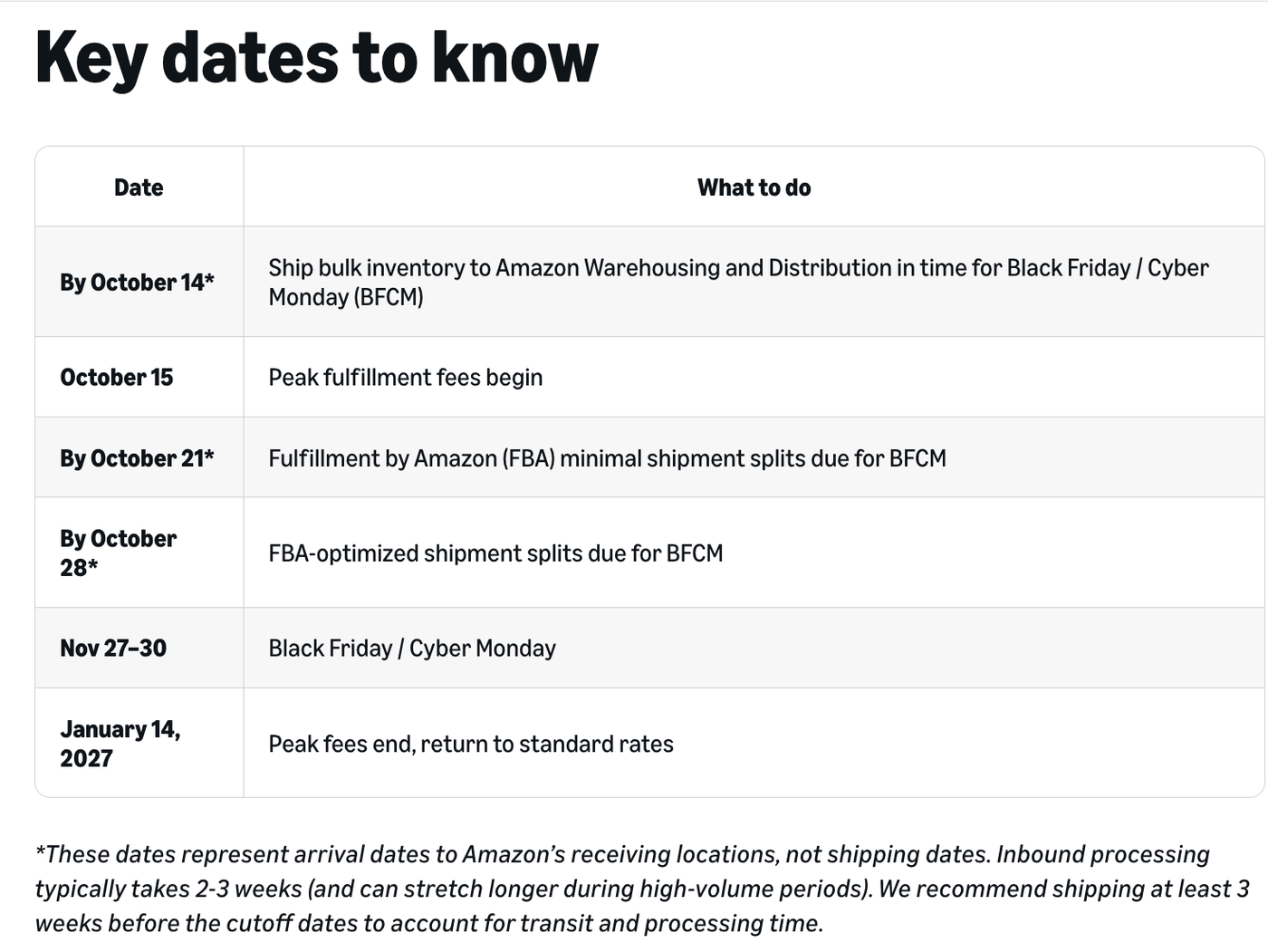
Source: Amazon Supply Chain — Peak Season Readiness Guide. Inventory deadlines are arrival targets, not dates on which sellers should dispatch shipments. Amazon recommends allowing additional time for transportation and receiving.
The operational implication is substantial. Sellers who have not already arranged inbound inventory need to assess whether their remaining replenishment options can realistically support their promotional plans.
Amazon also recommends positioning four to six weeks of inventory for top-selling products ahead of major events. That guidance highlights a fundamental trade-off: too little inventory can limit sales during peak demand, while too much inventory can leave capital tied up well beyond the promotional period.
2. The Black Friday advertising budget needs a profitability threshold
Holiday promotions can generate exceptional sales volumes, but higher order volume does not automatically produce higher contribution profit.
For Amazon sellers, PPC performance must be evaluated alongside promotional discounts, fulfillment costs, product margins and the additional costs associated with peak-season operations.
Consider an illustrative product with the following economics:
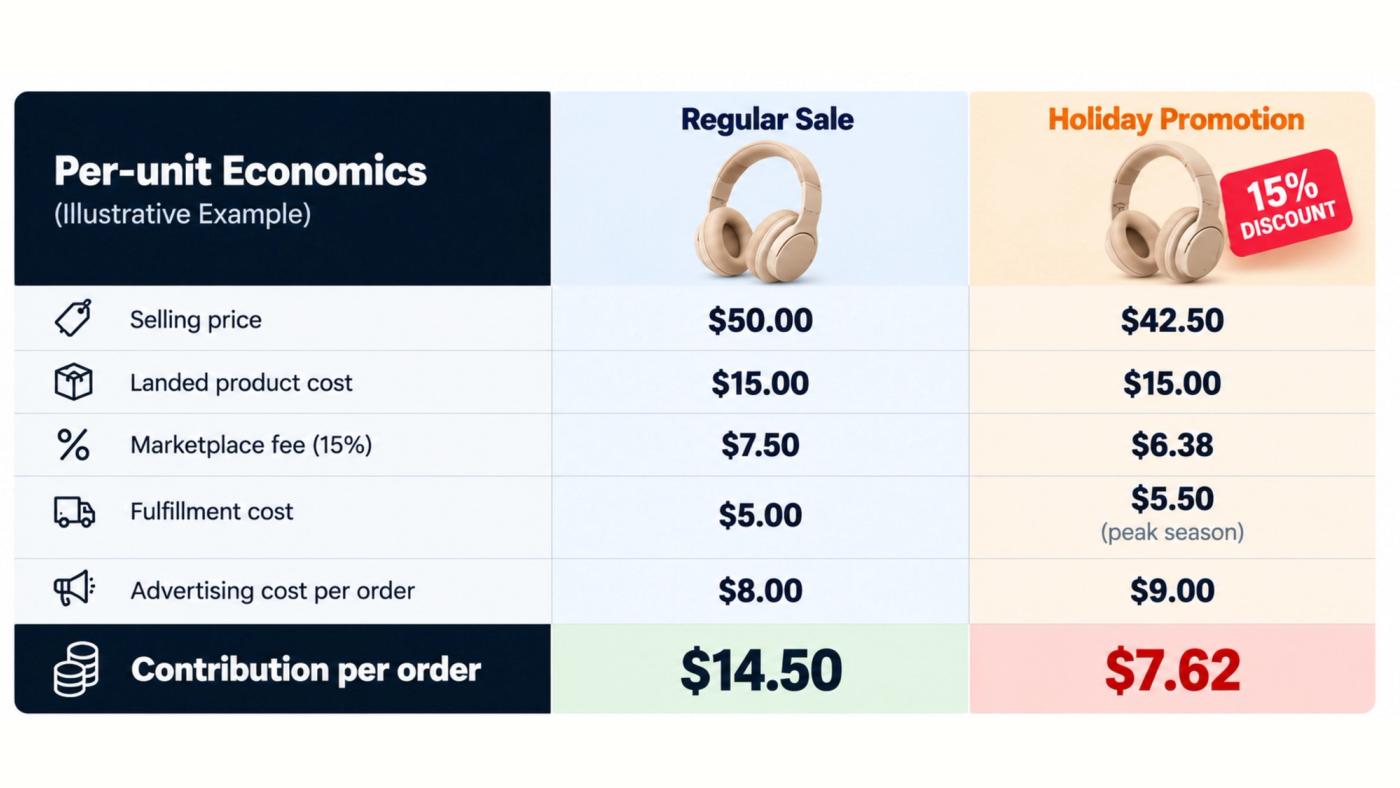
llustrative assumptions only, not quoted Amazon fees or a forecast. Excludes returns, storage, additional logistics and overhead. Figures rounded.
In this scenario, a 15% promotional discount, combined with higher advertising and fulfillment costs, reduces contribution per order by approximately 47%.
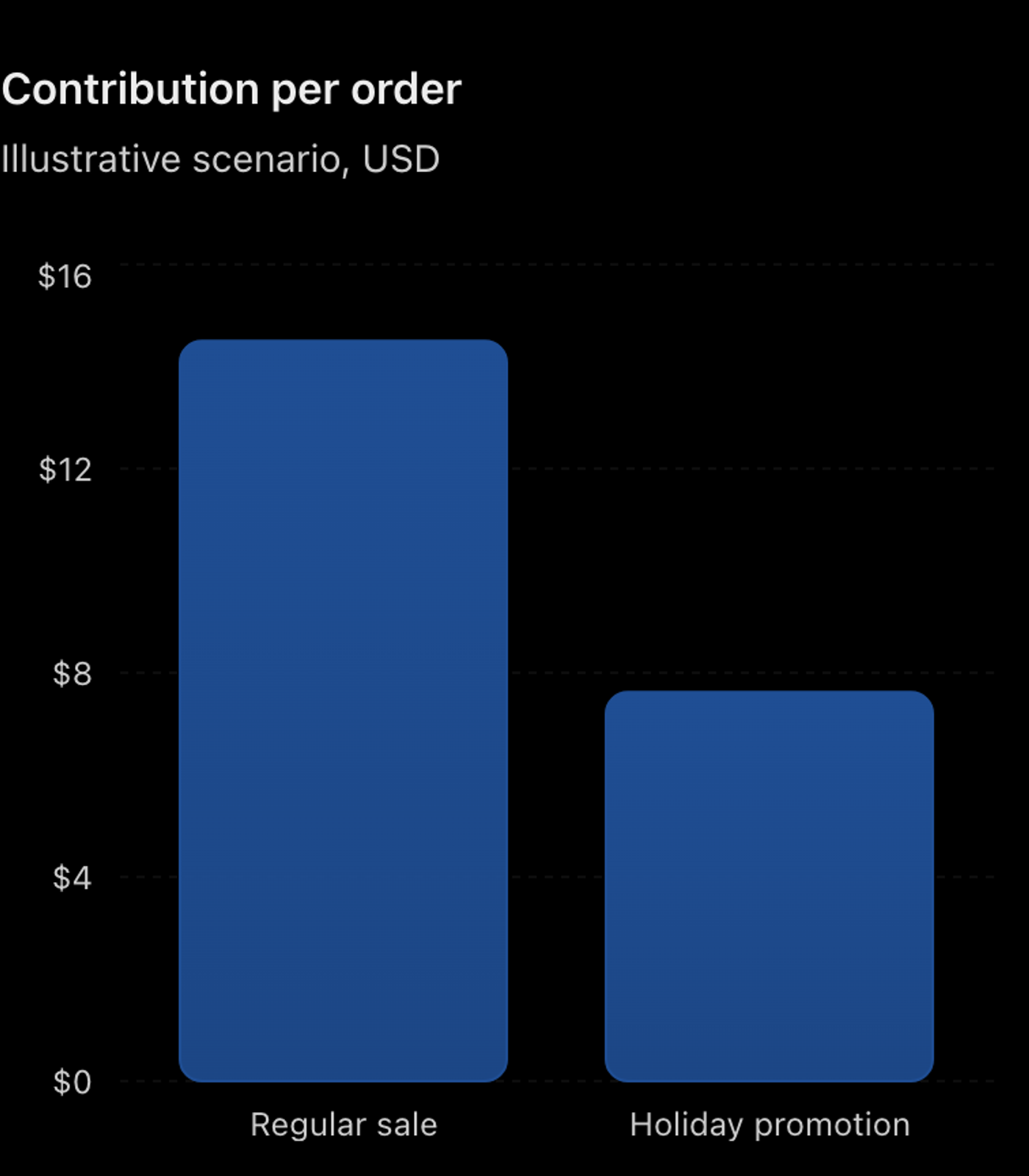
The seller would need to generate roughly 90% more orders during the promotion to produce the same total contribution as the original sales volume, assuming the illustrated costs remain unchanged.
That is why Q4 advertising decisions should be informed by more than ACOS, TACOS, impressions and conversion rates. Management also needs to understand the contribution margin available to fund incremental sales.
3. Inventory planning and cash-flow planning must operate together
Holiday inventory is often purchased well before the revenue it generates is collected. The business commits cash to stock, inbound freight, storage and advertising before those expenditures have been recovered through sales.
This creates an important working-capital challenge.
An aggressive inventory forecast may support stronger sales, but it can also reduce the cash available to finance advertising, replenishment and everyday operations. Conversely, an overly conservative purchasing decision can leave a profitable product unavailable during its strongest demand period.
The challenge becomes more complex for businesses operating across Amazon, Shopify, Walmart and other channels. Inventory may be distributed across fulfillment networks while the financial commitments supporting that inventory remain concentrated within the same business.
A reliable Q4 plan therefore needs to connect forecast demand, available inventory, inbound inventory, expected sell-through, advertising commitments and cash requirements.
It should also account for what happens after the peak. Inventory that remains unsold in December can require discounting or extended storage, while holiday returns can delay the recovery of working capital into January.
4. Five metrics management should review before increasing Q4 spend
For ecommerce businesses preparing for the final weeks of the year, these five measures provide a more commercially useful readiness assessment than revenue targets alone.
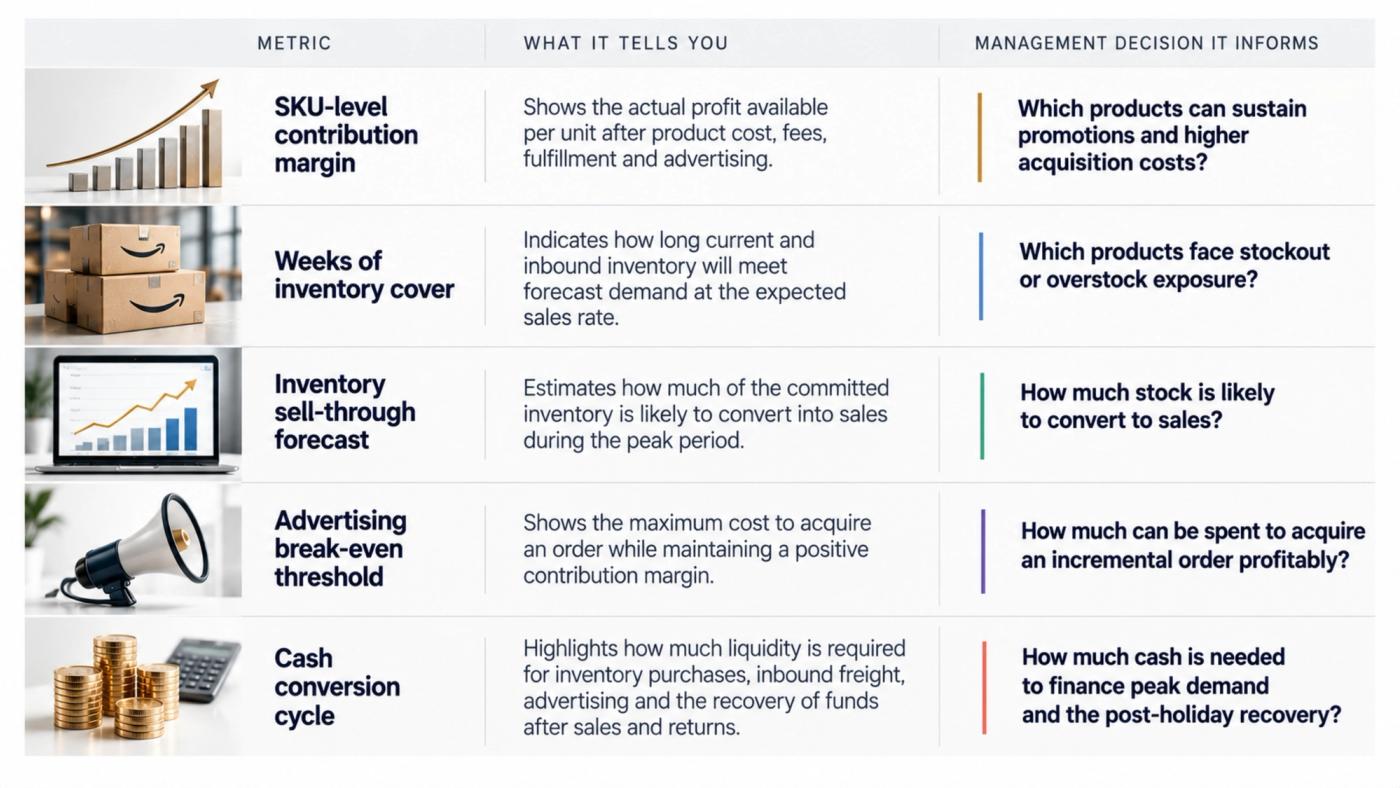
These measures are interdependent. A product may have attractive contribution margins but insufficient stock. Another may have strong inventory availability but require advertising expenditure that eliminates its economic advantage.
The objective is to identify those constraints before they become expensive operating decisions.
The executive perspective: Q4 readiness is a financial discipline
Black Friday and Cyber Monday are frequently managed as marketing events. For a mature ecommerce business, they are equally important tests of inventory productivity, capital allocation and operational coordination.
The strongest Q4 performance will not necessarily come from the largest discounts or the highest advertising expenditure. It will depend on whether the business has positioned the right products, financed the right inventory, protected its contribution margins and retained enough flexibility to respond as demand develops.
This is where Crystal Magnate's approach to integrated ecommerce operations becomes relevant.
Through EcomSpine (Formerly known as CMPulse), CM Vista and its specialist operational and financial services, Crystal Magnate brings inventory, marketplace performance, advertising and financial information into a connected decision-making environment.
That visibility helps management assess not only how much revenue the holiday season can generate, but also what the business must commit to generate it, and what is likely to remain afterward.
For Q4 2026, commercial readiness should be measured not simply by the volume of orders a business can fulfill, but by the quality of the financial outcome those orders produce.