
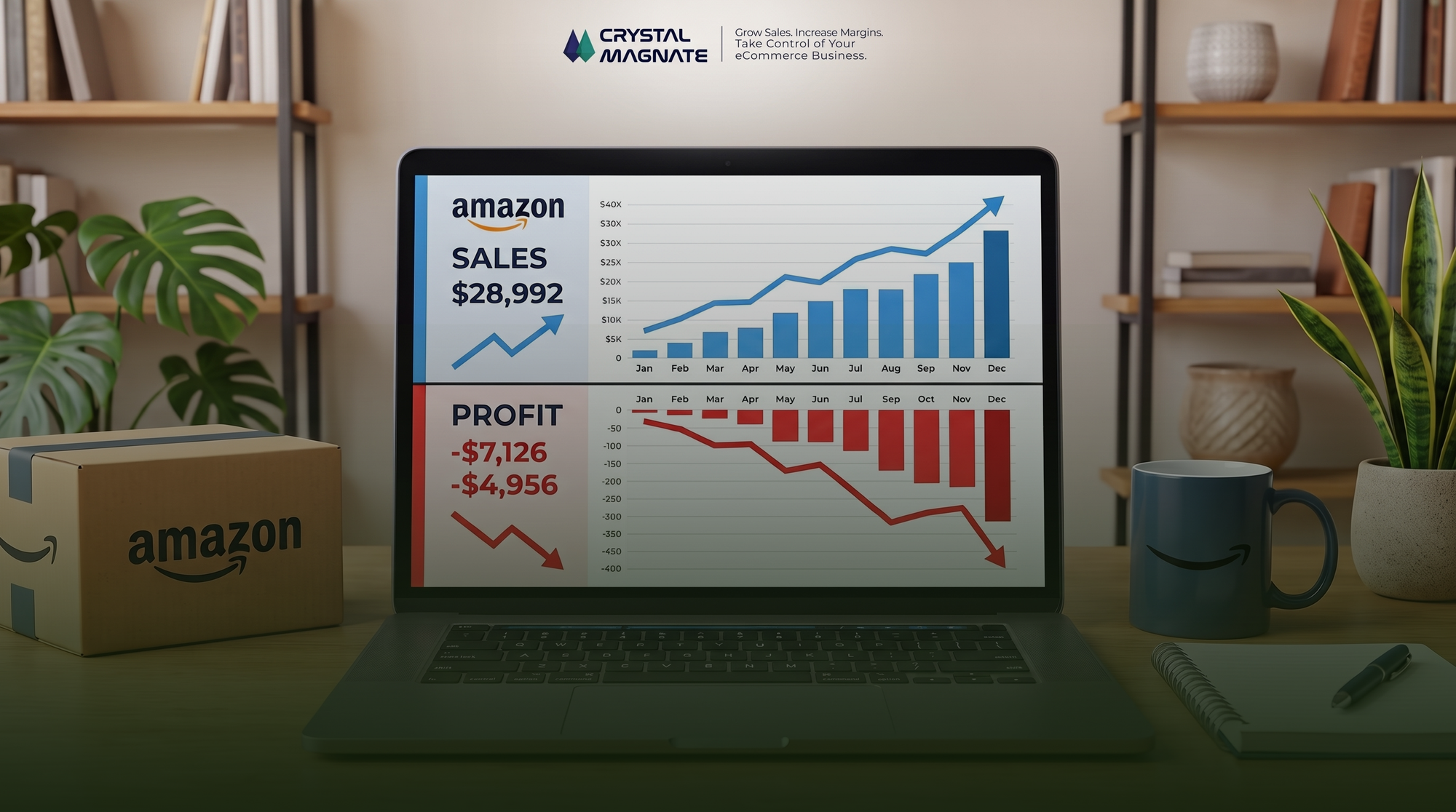
Your Amazon business can look successful on the surface.
Sales are growing. Orders are coming in. PPC campaigns are running. Your products are ranking. Maybe you have even launched new SKUs and expanded into new marketplaces.
But then you look at the numbers.
Revenue is up, yet profit has barely moved.
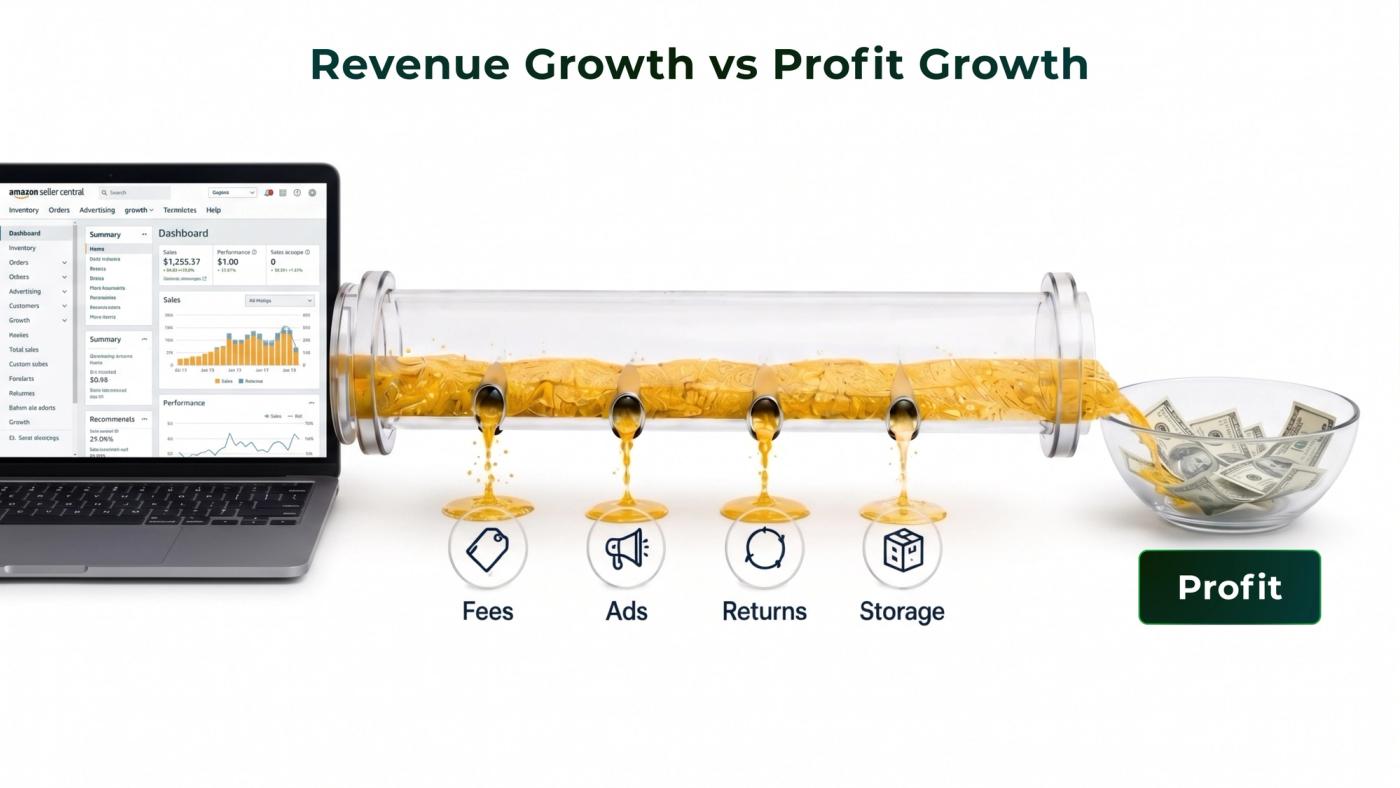
Advertising is taking a bigger share of every sale. Inventory is tying up more cash. Amazon fees keep adding up. Some products are selling constantly but somehow contribute very little to the bottom line.
This is where many Amazon businesses get stuck.
The problem is often not a lack of sales. It is that growth is happening without enough control over the economics behind that growth.
Crystal Magnate, looks at eCommerce growth differently. Revenue matters, but profitable revenue matters more. The objective is not simply to sell more, it is to understand where profit is being created, where it is leaking, and what needs to change to make growth sustainable.
In this guide, we’ll break down the most common reasons Amazon businesses struggle to become more profitable, the warning signs you should be watching, the numbers that matter most, and a practical 90-day framework for getting back in control.
Why Amazon Businesses Struggle Even When Sales Are Growing
Most Amazon businesses do not suddenly become unprofitable because of one catastrophic mistake.
More often, profitability deteriorates gradually.
A campaign that was once efficient becomes expensive.
A product's conversion rate slips.
A competitor forces a price reduction.
Returns increase.
Storage costs accumulate.
A new SKU absorbs advertising and launch costs for months.
Individually, none of these problems may look serious.
Together, they can completely change the economics of the business.
This is why one of the most dangerous situations for an Amazon seller is growing revenue while losing visibility into contribution margin.
If you do not know which products, campaigns and channels are creating profit, growth can actually make the problem worse.
The 8 Biggest Profitability Problems We See in Amazon Businesses
These problems generally fall into four areas:
Product economics
PPC and conversion
Inventory and cash flow
Marketplace operations and business control
Let's look at each one.
Product Economics
1. Selling Products That Were Never Economically Strong
Some products are difficult to make profitable from the beginning.
The market may be crowded.
The selling price may be too low.
The product may be expensive to manufacture or ship.
Amazon fees may consume too much of the selling price.
Or the product may require aggressive PPC simply to remain visible.
A product can have excellent sales velocity and still be a poor business decision.
Before scaling a SKU, you should understand:
- Selling price
- COGS
- Amazon fees
- Fulfillment costs
- Storage
- Returns and refunds
- Promotional discounts
- PPC spend
- Contribution margin
- Cash tied up in inventory
The important question is not:
"How much does this product sell?"
It is:
"How much profitable contribution does this product create?"
2. Confusing Revenue With Profit
This is one of the most common problems in eCommerce.
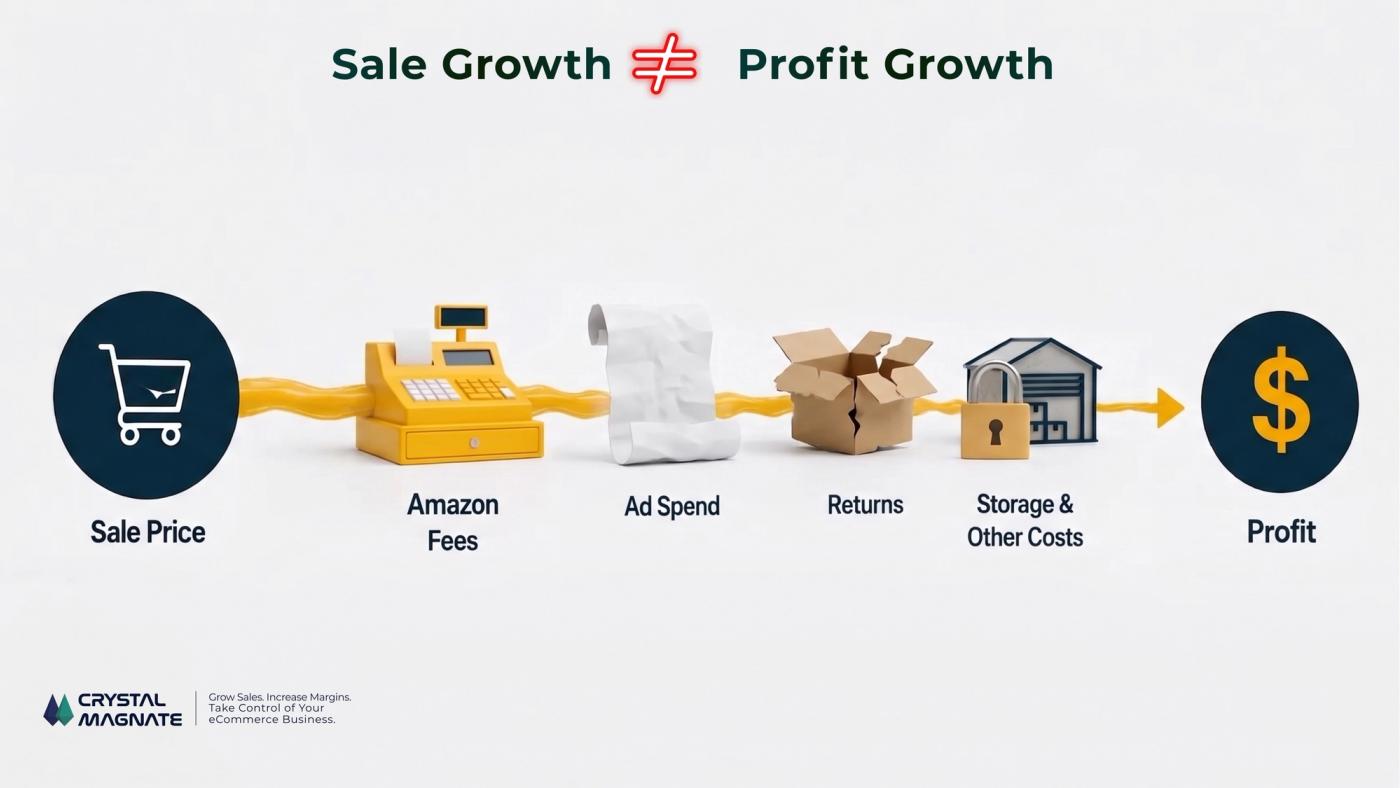
Imagine a product generates $100 in revenue.
That number looks good.
But after COGS, Amazon fees, fulfillment, advertising, discounts, returns and other variable costs, perhaps only $12 remains.
Now imagine another product generates $70 but leaves $20 after its variable costs.
Which product deserves more attention?
The answer is not obvious if you are only looking at revenue.
This is why Crystal Magnate's approach focuses on profitability at the SKU and campaign level, rather than treating total marketplace revenue as the primary measure of success.
A business cannot scale sustainably if it does not understand what is left after the costs required to generate each sale.
PPC and Conversion
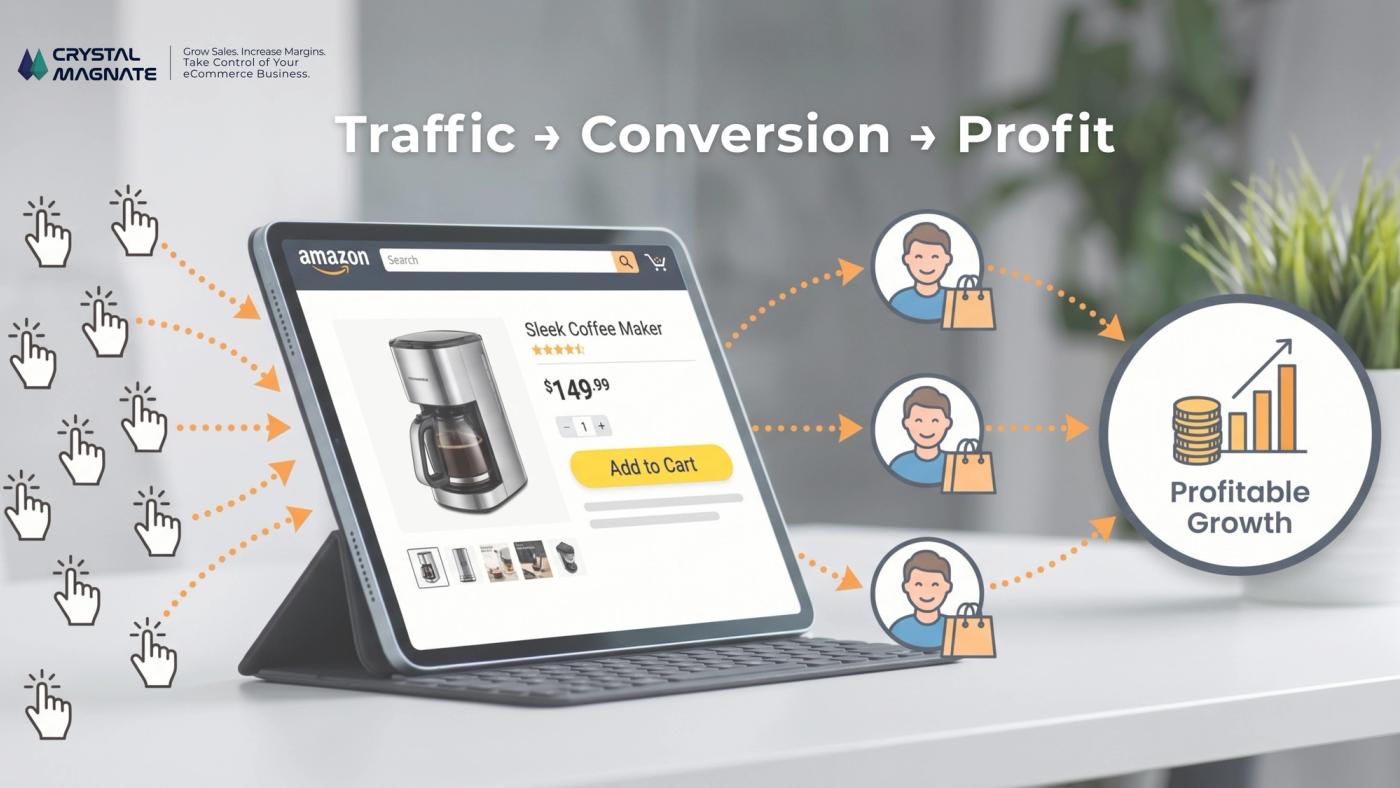
3. Letting PPC Consume the Growth
PPC is essential for most Amazon businesses.
But there is a difference between using advertising to create growth and using advertising to manufacture revenue that does not produce enough profit.
A campaign may generate thousands of dollars in attributed sales and still be economically weak.
Watch metrics such as:
- ACOS
- TACOS
- ROAS
- Conversion rate
- CPC
- CTR
- Organic sales contribution
- New-to-brand sales
- Profit contribution after advertising
The right advertising target is not necessarily the lowest ACOS.
Sometimes spending more on PPC makes sense if it creates profitable incremental sales and improves organic performance.
The real question is:
What does the additional advertising spend contribute to the business?
4. Treating Listings as a One-Time Project
A product listing is not something you optimize once and forget.
Customer expectations change.
Competitors improve.
Search behavior evolves.
Amazon's marketplace changes.
And conversion performance can deteriorate even while traffic remains stable.
When conversion drops, the economics of PPC can deteriorate quickly.
You may pay for the same number of clicks but generate fewer orders.
That means higher acquisition costs, weaker advertising efficiency and greater pressure on margin.
A strong optimization process should continuously evaluate:
- Search visibility
- CTR
- Conversion rate
- Keyword relevance
- Main image performance
- Content quality
- Reviews and ratings
- Competitive positioning
- Pricing
- A+ content
- Promotional strategy
Inventory and Cash Flow
5. Growing Inventory Faster Than the Business Can Absorb It
Inventory problems usually appear in two forms.
Too much inventory.
Or not enough inventory.
Excess inventory ties up cash, increases storage exposure and can eventually force discounting.
Stockouts create a different problem.
You lose sales velocity, ranking momentum and potentially customers who move to competitors.
Neither problem should be managed purely by instinct.
Inventory decisions should be connected to:
- Historical sales velocity
- Forecast demand
- Lead times
- Seasonality
- Current inventory
- Advertising plans
- Promotional calendars
- Cash availability
- Target stock levels
The goal is not simply to have "enough stock."
The goal is to have the right amount of capital invested in inventory at the right time.
6. Ignoring the Cash Behind the Growth
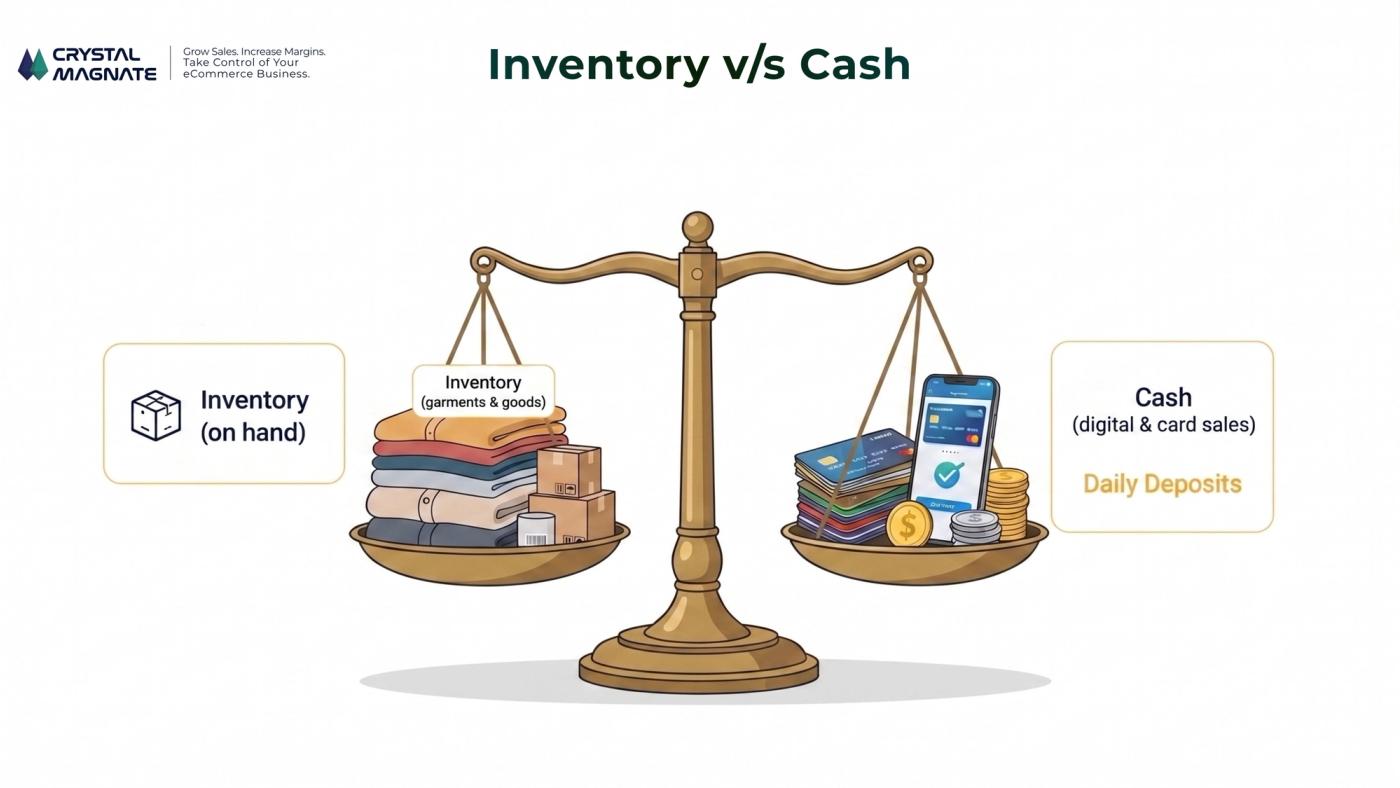
A business can be profitable on paper and still experience cash pressure.
Why?
Because inventory has to be purchased before it becomes revenue.
Advertising has to be funded.
Suppliers need to be paid.
Amazon settlement cycles affect when cash becomes available.
And growth itself can increase the amount of working capital required.
This creates a common Amazon trap:
Sales increase → inventory requirement increases → cash gets tied up → business feels cash-poor despite growing revenue.
That is why profitability analysis should be paired with cash-flow visibility.
Growth should strengthen the business, not continuously increase its dependence on working capital.
Marketplace Performance and Operational Control
7. Scaling Without Watching the Right Warning Signals
Amazon gives sellers an enormous amount of data.
The problem is that more data does not automatically create better decisions.
You need to know which numbers deserve attention.
At a minimum, keep an eye on:
- Account health
- Buy Box performance
- Conversion rate
- Return rate
- Inventory availability
- Listing performance
- Advertising efficiency
- Customer feedback
- Sales velocity
The goal is not to monitor every metric every day.
It is to identify the numbers that can signal a problem before that problem becomes expensive.
A declining conversion rate today may become a PPC efficiency problem next month.
A slow-moving SKU today may become an inventory write-down later.
A margin decline today may become a cash-flow problem tomorrow.
Early visibility gives you more options.
8. Scaling Everything Instead of Scaling What Works
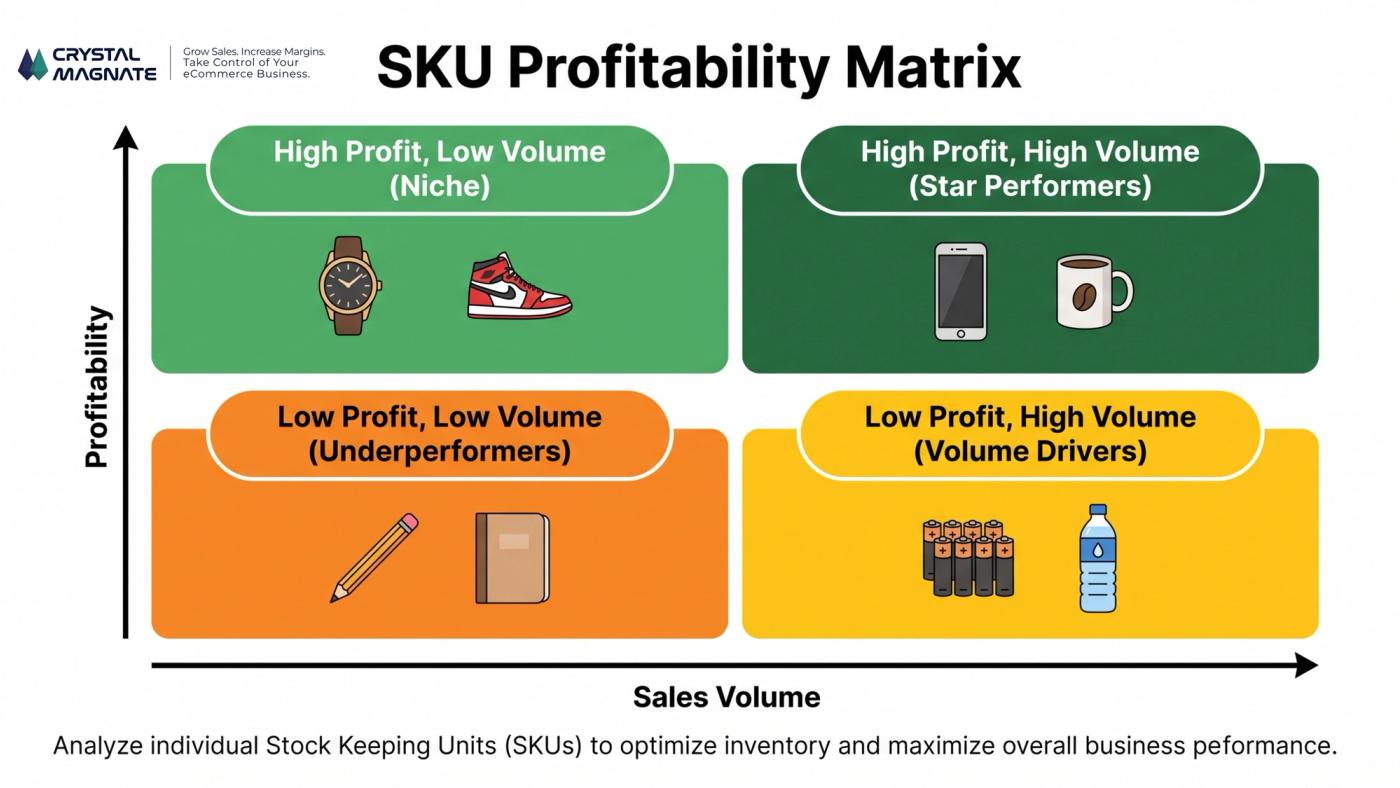
One of the biggest mistakes growing sellers make is treating every SKU as if it deserves the same investment.
It doesn't.
Some products are:
- High revenue / high profit
- High revenue / low profit
- Low revenue / high profit
- Low revenue / low profit
These products should not receive the same pricing, PPC, inventory or management strategy.
Your best growth opportunities may not always be your biggest sellers.
Sometimes the opportunity is hidden inside a smaller SKU with strong contribution margins.
Sometimes the right decision is to reduce investment in a high-revenue product that is consuming disproportionate amounts of cash and advertising spend.
Scale what creates value, not simply what creates volume.
The Amazon Metrics Most Sellers Should Watch
Revenue is important.
But it is only one piece of the picture.
A stronger Amazon performance dashboard should bring together commercial, advertising, operational and profitability metrics.
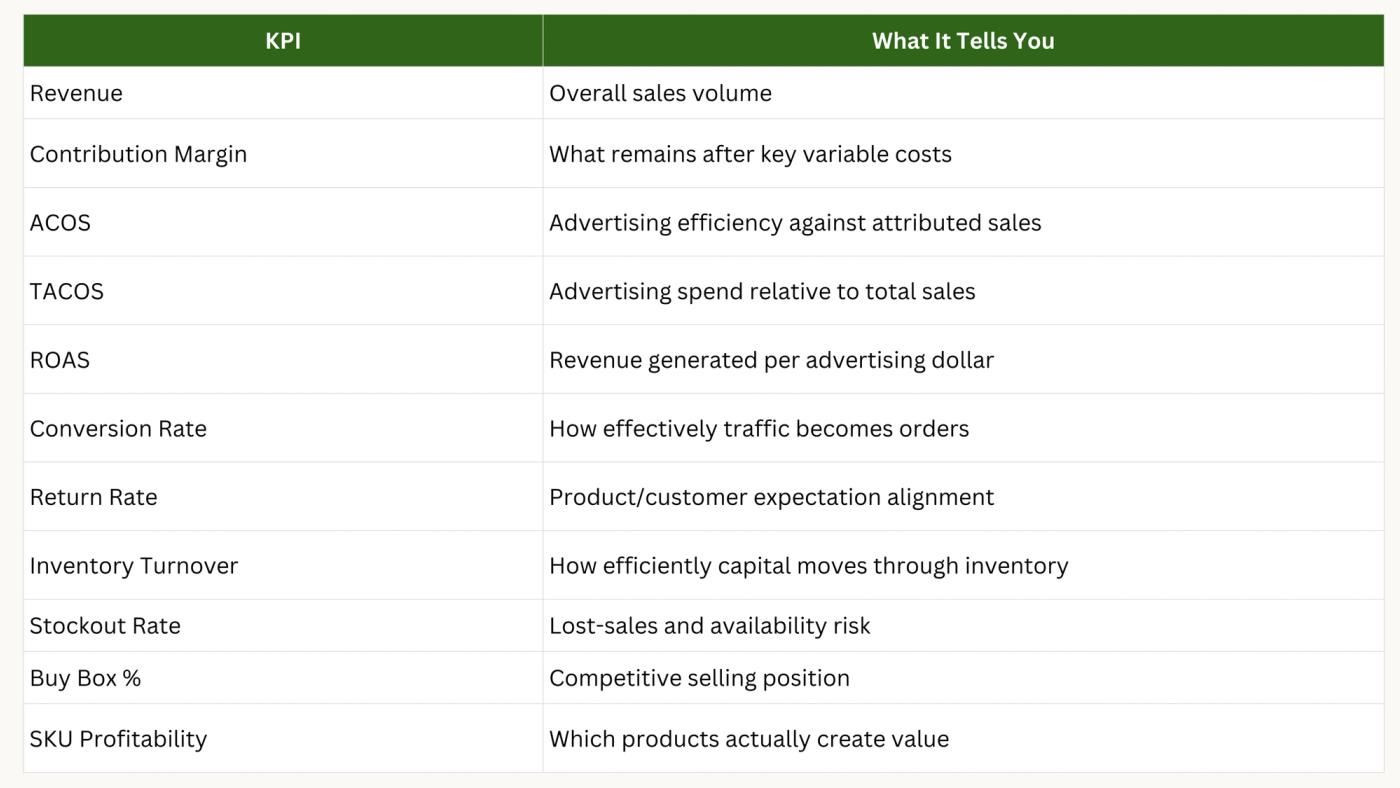
The important part is not simply tracking these numbers.
It is connecting them.
For example:
A falling conversion rate can increase PPC costs.
Higher PPC costs can reduce contribution margin.
Lower contribution margin can make an otherwise successful SKU unattractive.
That is the kind of relationship a useful eCommerce dashboard should expose.
A Simple Way to Think About Amazon Profitability
Instead of asking:
"How much did we sell?"
Start asking:
"What did it cost us to generate those sales, and what did we actually keep?"
Then take it one level deeper:
"Which products created the most profitable growth?"
And deeper still:
"What can we change to create more of that growth?"
That is the foundation of profitable eCommerce management.
The 90-Day Amazon Profitability Turnaround Plan
If your Amazon business is growing but profitability is not keeping pace, you do not necessarily need to rebuild everything.
You need to identify the biggest leaks first.
A practical 90-day approach can look like this.
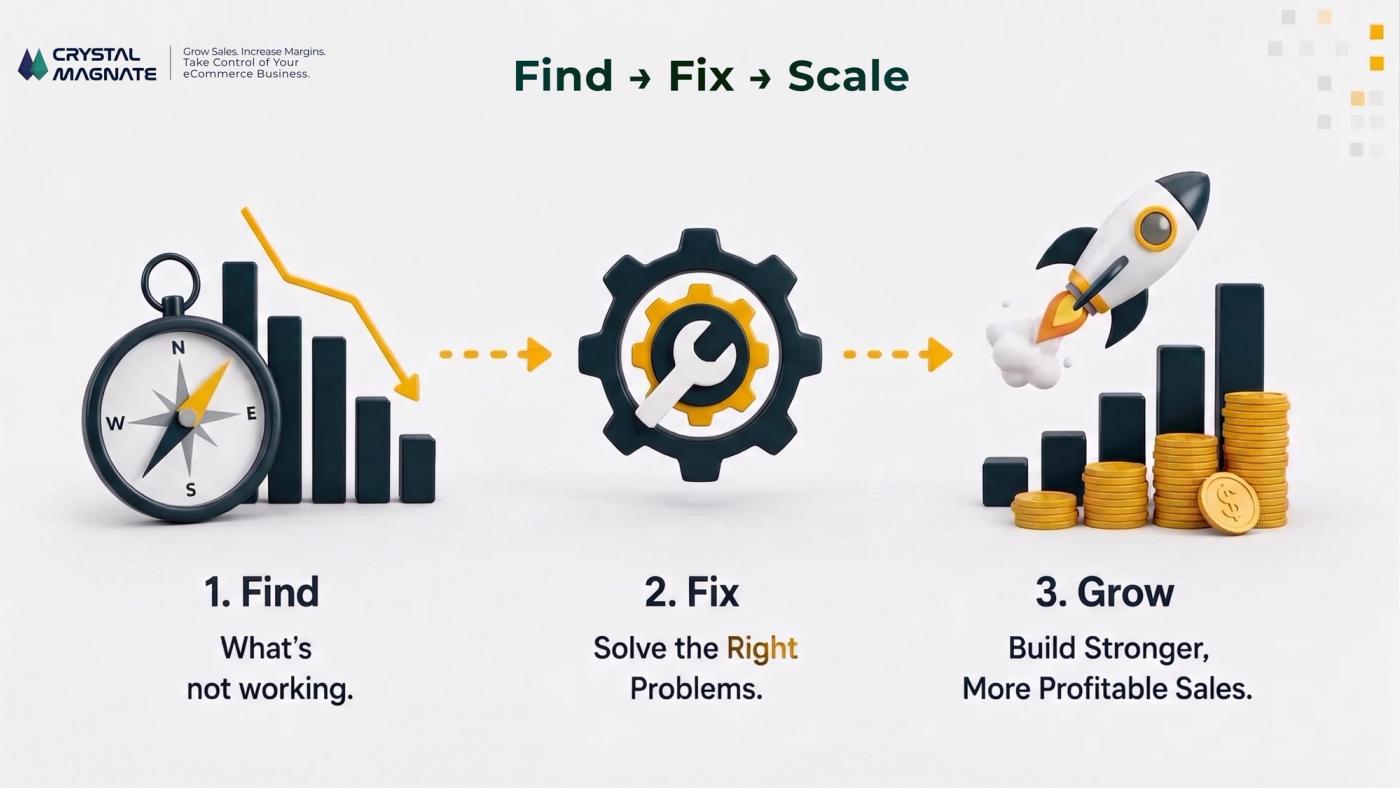
Days 1-30: Find Where the Money Is Going
The first month is about visibility.
Review your economics
- Calculate contribution margin by SKU
- Identify your most and least profitable products
- Map all major variable costs
- Review PPC spend by product
- Identify margin compression
- Compare revenue growth against profit growth
Review your marketplace performance
- Check conversion rates
- Review Buy Box performance
- Identify declining listings
- Review returns
- Examine inventory velocity
- Identify stockout and overstock risks
The objective is simple:
Find the biggest sources of profit leakage.
Days 31-60: Fix the Biggest Leaks
Once the problems are visible, prioritize.
Do not attempt to optimize everything at once.
Focus on the areas with the greatest financial impact.
Depending on what the data shows, that could mean:
- Cutting inefficient PPC spend
- Reallocating advertising budgets
- Improving conversion on high-potential listings
- Repricing weak-margin products
- Reducing unnecessary promotions
- Liquidating slow-moving inventory
- Adjusting purchase quantities
- Improving high-value SKU economics
- Fixing operational inefficiencies
The goal is not to make the business look better in a dashboard.
It is to put more profit back into the business.
Days 61-90: Build a Repeatable Growth System
The final stage is about preventing the same problems from returning.
Create a simple operating rhythm.
Weekly
Review:
- PPC performance
- Inventory risks
- Conversion changes
- Major SKU movements
- Marketplace/account issues
Monthly
Review:
- SKU profitability
- Contribution margin
- Advertising efficiency
- Inventory performance
- Cash requirements
- Revenue vs profit growth
Quarterly
Review:
- Product portfolio
- Pricing strategy
- Marketplace expansion opportunities
- Product-level investment
- PPC strategy
- Inventory strategy
- Overall profitability
The objective is to move from reactive management to controlled growth.
The Real Goal Isn't More Sales. It's Better Growth.
Amazon gives sellers an enormous opportunity to scale.
But scaling a business without understanding its economics can create a dangerous illusion.
The store gets bigger.
The revenue gets bigger.
The advertising budget gets bigger.
The inventory investment gets bigger.
And somehow, the profit doesn't.
That is not a growth problem.
It is a growth-quality problem.
The strongest Amazon businesses understand what is happening underneath the revenue number.
They know which products deserve more investment.
They know where advertising is creating incremental value.
They know which inventory is productive and which is tying up cash.
And most importantly, they know where profit is leaking before the leak becomes a crisis.
Ready to Turn Growth Into Profit?
If your Amazon business is generating revenue but the bottom line isn't moving at the same pace, the answer may not be "sell more."
It may be time to understand where the money is going.
At Crystal Magnate, we work alongside eCommerce businesses to improve profitability across the areas that matter most, from PPC and marketplace performance to product economics, inventory, margins and the systems behind sustainable growth.
More revenue is good. More profitable revenue is better.
If you want to understand where your eCommerce business is losing profit, and what to fix first, let's find it.
For Website Only
Frequently Asked Questions
Why is my Amazon revenue increasing but profit decreasing?
Revenue can increase while profit falls when PPC costs, Amazon fees, fulfillment expenses, returns, discounts, COGS or inventory costs increase faster than sales. The first step is to analyze contribution margin at the SKU level.
What is the biggest profitability mistake Amazon sellers make?
One of the biggest mistakes is managing the business around revenue instead of contribution margin. A high-selling product is not necessarily a high-profit product.
Should I always try to lower my ACOS?
Not necessarily. A higher ACOS can be acceptable when advertising is generating valuable incremental sales, supporting organic growth or helping launch a strategic product. The better question is whether the additional spend creates sufficient economic value.
How do I know which Amazon products I should scale?
Look beyond sales volume. Evaluate contribution margin, conversion rate, advertising efficiency, inventory requirements, return rates and growth potential. Products that combine strong demand with healthy economics are usually better candidates for additional investment.
How often should I review Amazon product profitability?
A monthly review is a strong baseline for most growing businesses, while major changes in pricing, PPC, COGS or marketplace conditions should trigger an earlier review.
Can a product with strong sales still be losing money?
Absolutely. High revenue can hide weak economics when advertising, fees, fulfillment, returns, promotions and product costs consume most of the selling price.
What should I do first if my Amazon business is struggling with profitability?
Start with visibility. Build a SKU-level profitability view, identify your largest sources of margin leakage, and prioritize the problems with the greatest financial impact. Fixing everything simultaneously usually creates more complexity rather than better results.
Is growing revenue always a good thing?
Not if the growth destroys cash or margin. The goal should be profitable, sustainable growth, where additional revenue contributes positively to the overall economics of the business.