
Why the cost of a return extends far beyond the refund
Returns have always been part of ecommerce. What is changing is the scale of the infrastructure now being built around them.
On September 29, UPS and TikTok Shop announced an exclusive U.S. returns partnership allowing TikTok Shop customers to make box-free, label-free returns at nearly 10,000 UPS Store locations. The returned product is verified at the counter, while AI-supported processes help validate the transaction and identify potential fraud.
The announcement is significant because it addresses one of ecommerce's persistent contradictions: customers expect returns to become easier, while the economics of processing those returns are becoming harder for retailers to ignore.
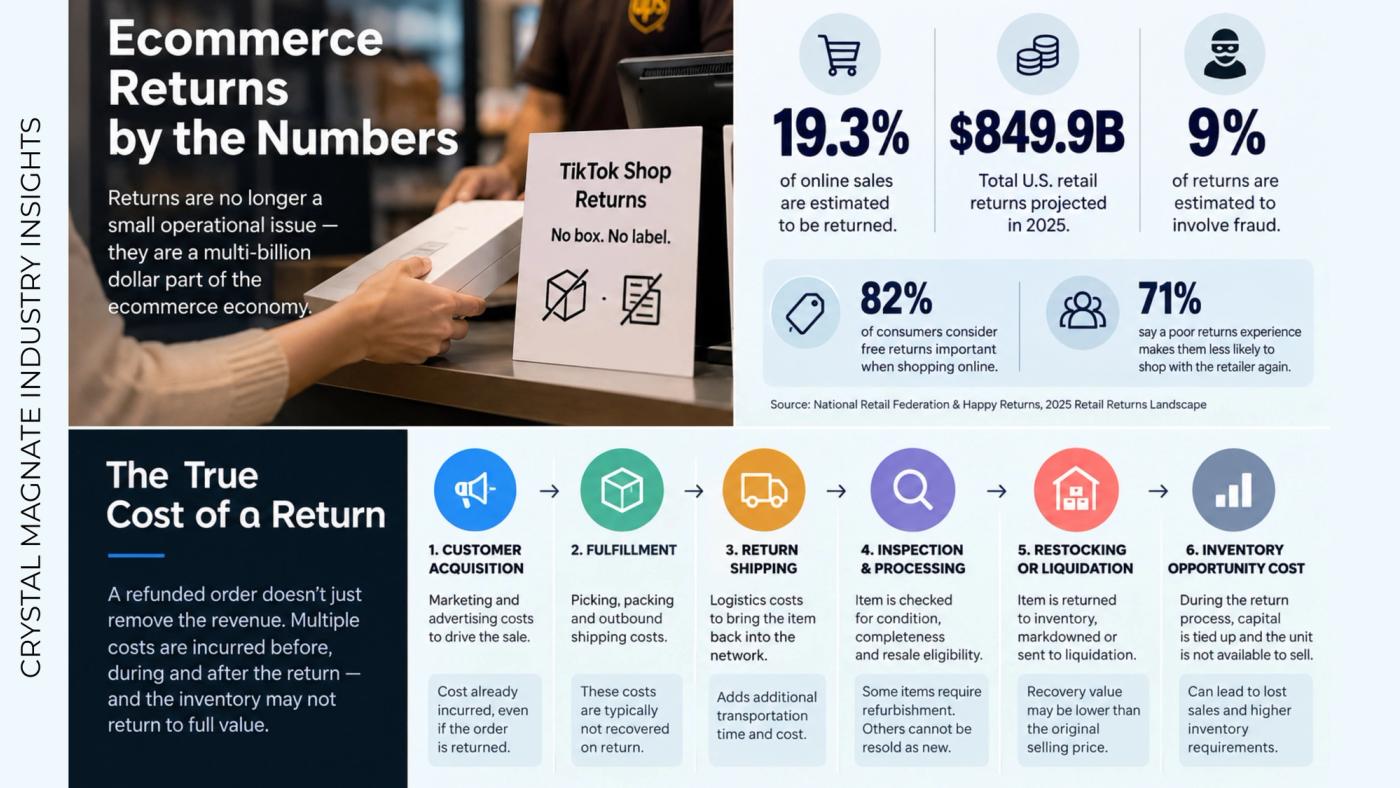
Reuters estimates that approximately 20% of online sales are returned, representing around $850 billion of merchandise in 2025.
At that scale, returns are no longer simply a customer-service function. They are a material part of ecommerce economics.

UPS and TikTok Shop are making returns easier for customers while adding physical verification and AI-supported fraud controls to the reverse-logistics process.
UPS and TikTok Shop are making returns easier for customeUPS and TikTok Shop are making returns easier for customers while adding physical verification and AI-supported fraud controls to the reverse-logistics process.rs while adding physical verification and AI-supported fraud controls to the reverse-logistics process.
https://www.reuters.com/business/ups-signs-exclusive-deal-with-tiktok-shop-label-free-returns-2026-09-29/
The refund is only the visible cost
When a $100 order is returned, the financial consequence is not simply the reversal of $100 in revenue.
The business may already have paid to acquire the customer. It has picked, packed and shipped the order. Marketplace, payment or fulfillment costs may have been incurred. The return then creates another logistics journey, followed by inspection, processing and a decision about what happens to the product next.
The economics can therefore look more like:
Customer acquisition → fulfillment → outbound shipping → return shipping → inspection → restocking → resale, markdown or liquidation
And not every returned unit comes back as the same asset that left the warehouse.
Packaging may be damaged. Seasonal demand may have passed. The item may require refurbishment. Some products can no longer be sold as new. Others remain outside available inventory long enough to lose sales before they are processed and returned to stock.
The true cost of a return therefore sits across margin, logistics, inventory and working capital.
Returns change SKU economics
This is where return rate becomes more useful than a customer-service KPI.
Consider two products producing similar revenue and gross margin.
One has a 5% return rate.
The other has a 20% return rate.
At topline level, they may appear similarly successful. Once acquisition costs, fulfillment, reverse logistics and inventory recovery are considered, their contribution to the business can be materially different.
The same applies across channels.
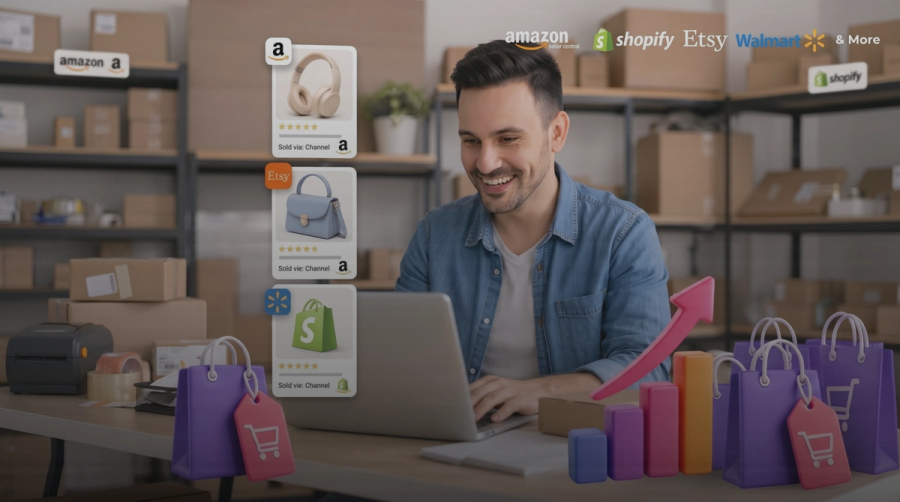
An Amazon SKU, a Shopify product, a Walmart listing or a TikTok Shop item can each carry different return policies, fulfillment economics and recovery processes. A consolidated company P&L may show that the business is profitable while masking products or channels where returns are systematically consuming contribution margin.
For operators, the more meaningful question is not simply:
How much did we sell?
It is how much of that revenue remained economically productive after returns were accounted for.
The second cost is inventory velocity
There is another consequence that receives less attention.
A returned unit does not immediately become usable inventory.
From the moment the customer initiates a return until the product is received, inspected and made available for resale, capital is effectively sitting inside the reverse-logistics process.
Multiply that across thousands of orders and returns begin affecting more than margin. They affect inventory availability, replenishment decisions and working capital.
This becomes especially important around peak periods.
If a business replenishes inventory based on units sold without properly incorporating expected returns and recovery timing, it can purchase too much stock. If returned inventory takes too long to re-enter the sellable pool, the same business can simultaneously experience an apparent stock shortage.
That is why return rate and inventory planning should not operate as separate datasets.
Then there is return fraud
The UPS–TikTok Shop announcement also points to another growing cost: verification.
The companies say the new process combines physical inspection at UPS Store locations with AI-powered validation intended to reduce fraudulent returns.
For ecommerce operators, fraud is not limited to obviously false refund claims. It can include different products being returned, used merchandise, empty packages, altered goods or abuse of increasingly convenient return policies.
The easier the customer experience becomes, the more important the controls behind that experience become.
Retailers are therefore trying to solve two competing objectives at once:
remove friction for legitimate customers while increasing scrutiny of economically damaging returns.
That balance will become increasingly important as marketplaces compete on convenience.
Returns belong inside the profitability model
The most useful shift for an ecommerce business is therefore not simply reducing its overall return rate.
It is understanding where returns are occurring, why they are occurring and what they actually cost.
That means looking at returns by SKU, channel, reason, customer segment and recovery outcome.
A product with a higher return rate may still be highly profitable. Another with fewer returns may generate greater losses if returned units cannot be resold. A channel with higher sales may become less attractive once reverse-logistics costs are allocated correctly.
The objective is not to eliminate returns.
It is to understand their economics well enough to make better decisions around pricing, product quality, inventory, fulfillment, advertising and channel strategy.
That is also why returns cannot sit isolated inside a marketplace dashboard or customer-service report.
Crystal Magnate connects these operating events back to financial performance through eCommSpine and CM Vista, bringing sales, inventory, costs and profitability into the same decision environment.
Because in ecommerce, the sale is not economically complete when the customer checks out.
It is complete when you know what stayed sold, what came back, what was recovered -and what remained profitable.