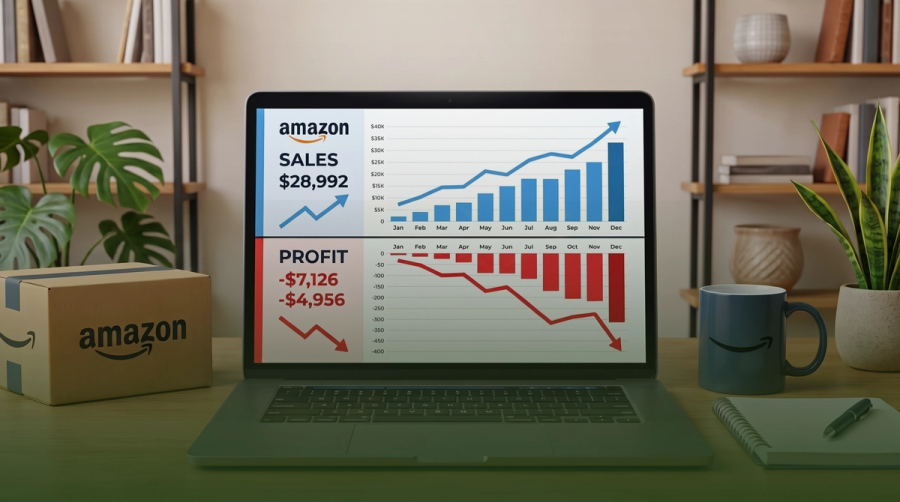
The state of the marketplace, in five numbers: ~1.65–1.9 million active third-party sellers worldwide today, down from 2.4 million in 2021 165,000 new seller registrations in 2026 - a 10-year low 20 -25% annual seller churn among active accounts 60.0% of all Amazon units sold worldwide now come from third-party sellers Only 10 - 20% of FBA sellers achieve consistent, meaningful profitability
Read those together and the story isn't "Amazon is shrinking." It's the opposite. Third-party sellers are doing more volume than ever, on a marketplace with fewer new entrants and a shrinking pool of survivors.
The gold-rush phase, where showing up and listing a decent product was enough, is over. What's left is a smaller, more professionalized field, and the sellers falling out of it aren't losing on product. They're losing on margin.
This edition breaks down exactly where that margin is going, with the numbers behind each pressure point, and what separates the operators absorbing it from the ones bleeding out.
1. Fee Compression: Death by a Thousand Cuts
No single Amazon fee change is large enough to sink a business on its own. That's precisely why this is the hardest pressure point to manage, it doesn't show up as one alarming line item, it shows up as a slow, compounding drag across several at once.
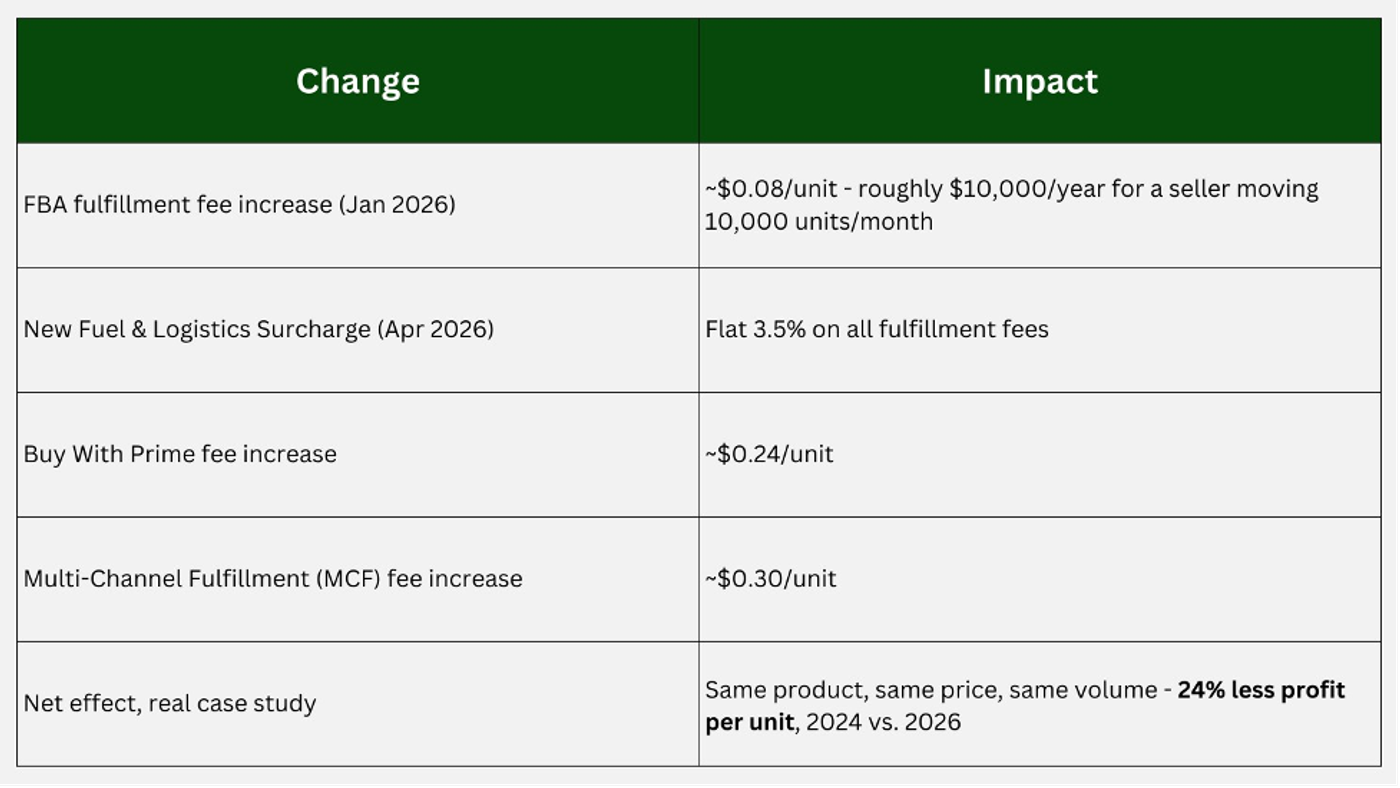
Each of these, evaluated in isolation on a monthly P&L review, looks negligible. Evaluated cumulatively and at the SKU level, they represent a structural erosion of unit economics that most sellers only discover once it has already compounded across a full fiscal year. By the time it shows up in a quarterly review, it isn't a $0.08 problem anymore, it's a double-digit margin problem, and the fix is much harder at that point than it would have been three fee changes earlier.
What separates the operators who absorb this: SKU-level contribution margin tracked weekly, not category-level P&L reviewed monthly. The gap between those two cadences is currently the single biggest predictor of who catches fee compression early enough to price, negotiate, or reformulate around it, and who doesn't.
2. Advertising Inflation: The Arms Race Has a Ceiling Problem
Average CPC: $1.18 - $1.25, up 12% year over year Q4 peak CPC projected to reach $1.45 Average ACoS across Amazon advertising: approaching 30%, up from the low twenties two years ago
This is not a temporary spike, it's a structural shift in the economics of paid visibility on Amazon. As more third-party sellers compete for the same inventory of search real estate, and as Amazon's own ad load increases, CPC inflation isn't cyclical, it's compounding. Sellers still budgeting advertising as a fixed percentage of revenue, rather than managing it against a real TACoS ceiling, are effectively funding a bidding war that gets more expensive every quarter, with no natural floor.
The operators pulling ahead here aren't spending less. They're spending against a defined contribution-margin threshold per SKU, cutting spend the moment a keyword or ASIN crosses it, something that's operationally impossible without real-time, SKU-level visibility into blended advertising cost against actual margin, not just revenue.
3. The Rufus / Search Relevance Shift
Rufus AI now handles roughly 25% of all product queries on Amazon Listings optimized for legacy keyword-density SEO are being systematically deprioritized in favor of listings that directly answer specific customer questions
This is arguably the least understood shift on this list, because it doesn't look like a penalty. There's no suspension notice, no policy strike, no dramatic drop in a single day. It looks like slow, unexplained erosion in organic visibility, exactly the kind of decline that gets misdiagnosed as "seasonality" or "increased competition" when the real cause is a catalog built for a search algorithm that no longer exists in its old form. Sellers who haven't rebuilt listing content around conversational, question-answering copy are losing share to competitors who have, often without realizing why.
4. Cash Flow: The Quiet Compression
A "DD+7" payout delay took effect March 2026, extending the gap between sale and disbursement Tariff-driven input cost inflation added an estimated $3 - 4 per unit on a $10 manufacturing cost for goods sourced from China in 2025, before partial rate adjustments
Combine slower payouts with higher landed cost per unit, and working capital gets squeezed from both directions simultaneously, right as reorder decisions require more confidence, not less. Sellers reordering inventory based on last quarter's cash position, rather than a live view of cash- in/cash-out by SKU, are the ones most exposed to a stockout or an overextension they didn't see coming.
5. The Profitability Reality Check
Only 10 - 20% of FBA sellers achieve consistent, meaningful profit A more optimistic dataset shows 64% reaching profitability within 12 months, but 46% of those sit at just 11 - 25% margins, and 22% never become profitable at all Roughly 20% of sellers exit within year one
However you read the data, the spread between "surviving" and "scaling" is enormous, and it isn't explained by product quality or market selection. It's explained by operating discipline.
The sellers clearing 25%+ margins consistently are not, on average, better merchandisers than the ones stuck at 11%. They have tighter visibility into where every dollar of revenue actually converts to profit, and they act on that visibility weekly instead of quarterly.
The Pattern Underneath All Five
Every one of these pressures, fees, advertising, search relevance, cash flow, and the profitability spread itself, traces back to the same root cause: Amazon is systematically shifting cost and operational complexity onto sellers, while raising the bar for what "professional" now means.
The sellers who scale in 2026 aren't the best marketers. They're the ones with SKU-level P&L visibility, fast reaction time to fee and algorithm changes, and enough cash and inventory discipline to absorb shocks that would sink a less prepared operation.
That is not a marketing problem. It's a visibility problem, and it's exactly the problem Crystal Magnate was built to solve.
The future of Amazon success will not be defined by businesses that simply sell more, it will be defined by businesses that operate more intelligently and profit more consistently. As operational complexity continues to increase, the real competitive advantage lies in transforming data into decisions, complexity into clarity, and growth into sustainable profitability.
Crystal Magnate exists to help Amazon businesses achieve exactly that. By enabling greater operational visibility, stronger financial intelligence, and better business decisions, Crystal Magnate empowers ambitious brands to build more profitable, scalable, and resilient businesses.
Book a Profitability Review with our team, a straight, data-first look at where your margin is actually going, no pitch attached.
Crystal Magnate Helping Amazon Businesses Build Smarter, More Profitable Operations.